Monday, 11 April 2016

JOHN HERBERT COMPER


John Herbert Comper was born on 30th May 1916 in Brixton, London; he was the younger son of Frederick Comper and his wife Minnie Gomersall.  Frederick worked in a munitions factory but, prior to WW1 he had been a commercial traveller selling porcelain, fine china and glassware from Continental Europe. 

John was a bright boy and, from 1928 to 1934, attended Sir Walter St.Johns School, Battersea after winning a county scholarship. He received a small bursary, which would become invaluable in the financial slump of the early 1930s.  This was a hard time for the Comper family - in John's own words: “My father’s health was failing and my brother was out of work, or gone to Ireland.”

John helped the family income by earning money, collecting payment of the weekly bills for a local newsagent and his mother found shop work when she could - but it wasn’t always enough:

“There were times when the weekend approached and the whole family would be at home and there was no sign of being able to find a meal for us all. Sometimes there were arrears in the rent.”  Fortunately they were helped on several occasions by a girlhood friend of John’s mother, and then later by her cousin and his bosses staying intermittently as paying guests.

In 1934, as John approached the end of his schooling, it became clear he would be unable to afford to take up the place he had been offered at University. Out of simple necessity, he sat the entrance exam for four different professions and was offered a position in the Civil Service, working for the Board of Education in the Staff Records Section of the Science Museum.

In 1935 his father died, aged 68, and times became harder. In 1937 John and his mother moved to Wembley to live with her recently widowed brother above his clothier's shop. John’s brother, George, was by now living and working in Malaya.

When war broke out in 1939, he stayed in the Civil Service until joining the RAF in 1940 when his age group was reached in the call-up process: “I had no impulse, patriotic or otherwise, to involve myself in the fighting any sooner than that,” he confided.

He enlisted on 17th June 1940 at RAF Cardington, Bedfordshire and was assigned as a Clerk in the General Duties branch. On 22nd August of that year he was posted to RAF Bramcote, Warwickshire for the formation of 304 Polish Bomber Squadron.

Just a week later, on the 29th August, his Service Record shows that he was admitted to RAF Hospital Cosford, about 50 miles away. He was discharged after 20 days and no explanation is given, leaving something of a mystery.  Squadron records show no enemy activity over the base at this time, but there were several bombs dropped on Nuneaton on the night of 28th August 1940, including one high explosive that killed three people and injured nine others, two of them seriously.

Nuneaton is only 4 miles from RAF Bramcote so it is possible that he was in the town that evening and was somehow caught up in this incident, or perhaps he was sent by the base commander as part of an aid party. Whatever the reason, it may relate to a story passed down the family that ‘something bad happened to him, resulting in some injury, and that what he had seen had given him a sort of breakdown and he had lost his faith’.  It could possibly have something to do with the fact that a nine year old girl was killed in that incident

Back at RAF Bramcote, he was one of 25 or so British advisory/liaison staff tasked with assimilating some 350 Polish Officers and airmen into the RAF way of doing things and it’s procedures and King's Regulations, simultaneously developing them into a viable fighting unit.

On the whole he found it “enjoyable for the variety and unpredictability of what came my way. On the other hand there were times of frustration and exasperation arising in the main from the inability to communicate details because of language difficulties”. The squadron achieved combat readiness on 25 April 1941, and by the end of that year John had been promoted to the rank of Corporal.

The nature of his work being administration means that there is a paucity of recorded information about his day-to-day activities and, in common with so many others, he never spoke about the war in later life. However, when asked many years later about any frightening experiences he had had, he recalled the following:

“Another man and I were working in a hut on the edge of Cardiff aerodrome when we saw an aircraft approaching quite low and we suddenly realised it was German. We shot out of the hut in the direction of a nearby underground air-raid shelter (as our standing instructions said we should, not that we needed any encouragement). Before I got there a bomb exploded about 50 yards away. The blast bowled me over on the ground, but I suffered no injury beyond a short nose-bleed. It was only afterwards I realised how frightened I had been.”

“Another, more frightening, but actually less dangerous, occasion was when a Stuka dive-bombed a small group of us outside a hangar on a Midlands airfield. He came out of the sky, seemingly straight for us, with a siren shrieking – designed, of course, to scare us (and succeeding). It dropped no bomb and was gone again in moments, but we all scattered fast. The noise of the siren was awful – worse almost than the thought that he was going to bomb or machine-gun us. (A Corporal among us shot through the hangar door at great speed and knocked a small light aircraft off it’s stands where it was being serviced. He couldn’t really be blamed, but was ever after known as Corporal Panic).

Throughout the war John’s character is recorded as very good and his proficiency as excellent.   In 1942 he was promoted to the rank of Sergeant and, in 1943, awarded a Good Conduct badge. He was also honoured by the Polish Air Force who awarded him  the Squadron Badge - very rarely given to British Officers and almost unheard of as an award to enlisted men and NCOs. In 1944 he was awarded a Mention In Despatches for his prolonged good service.


His cherished award of the Squadron Badge
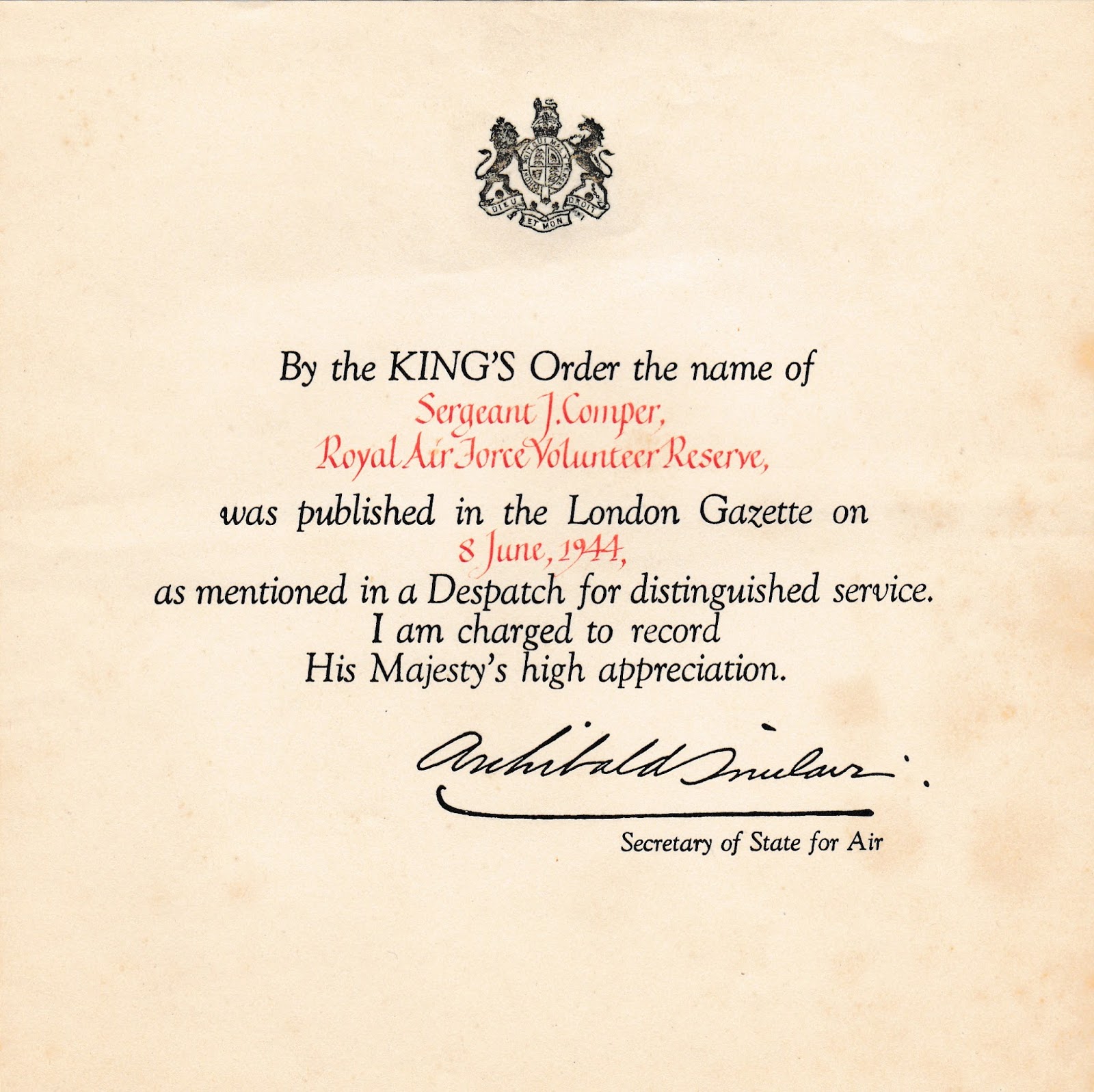
 
Mentioned in Despatches
 

By the end of the War, he had served with 304 Squadron at 14 RAF Stations, these being: Bramcote (Warwickshire), Syerston (Nottinghamshire), Lindholme (Yorkshire), Tiree (Inner Hebrides), Dale (Pembrokeshire), Talbenny (Pembrokeshire), Docking (Norfolk), Davidstow Moor (Cornwall), Predannack (Cornwall), Chivenor (Devon), Benbecula (Outer Hebrides), St Eval (Cornwall), North Weald (Essex) and Chedburgh (Suffolk).

He was a kind and even-tempered man, with impeccable manners, quiet but not shy, and loved telling silly jokes and riddles. His genial and straight-forward  approach to his work, coupled with his skill at untangling problems, seems to have been appreciated by the squadron. Eventually he became the assistant Adjutant, “working with a Polish officer who spoke quite good English (better, anyway, than my Polish!).”

In November 1945 he received news that his brother, George, had died in a Japanese POW camp in Borneo, a few days after it was liberated but before he could be moved out. George was a Lance Corporal in the 3rd Battalion of the Straits Settlements Volunteer Force, which had been over-run by the Japanese during their invasion of Singapore. The news of his death was all the worse because a telegram in September had said that George was alive and on his way home. He had in fact died on 14th June, their mother’s birthday.

John was demobbed on 25 February 1946 and returned to London and his job at the Science Museum. His RAF release book states ‘He possesses initiative, confidence and ability of exceptional standard and has capably performed superior duties.’

Highly thought of by his Polish Commanding Officer
 

Five months after returning to civilian life he received a parcel from 304 Squadron – a monogrammed cigarette case, hand - made by one of the Polish craftsmen. Inside was a list of everywhere they had been stationed, and also engraved was a personal message :- “To Johny Comper From the flying personnel with warm appreciation for your most valuable work with 304 Polish Squadron since its beginning 1940 to 1946”. Accompanying this gift was a letter from Wing Commander Witold Piotrowski thanking John for his long and devoted service and helping them over so many difficulties, not all of which were quite “in the line of duty”.


Presentation of engraved cigarette case
in appreciation of his service
 
in July 1946 John met Joyce Hobbs, an employee at the Science Museum,   and by the end of the year they were engaged. On 9th July 1947 they were married, the ceremony took place at All Saints Church, Fulham. They moved to a flat in West Kensington.  In 1950 they moved to a house in Barnes, SW London and had their first child, a daughter. John’s mother moved in to live with them and two years later a second daughter was born.


Wedding Photos of John and Joyce
 

Over the following years John developed an interest in horticulture and became an accomplished gardener, as well as developing a talent for being able to fix almost anything. If he couldn’t mend something he would soon find out how to do so. In the evenings he enjoyed reading, usually having several books on the go, especially spy stories.

Soon after returning to the Science Museum, John had been moved to the Ministry Of Education, where he served variously in Establishments Branch, Legal Branch and Further Education Branch until he was appointed Superintendent of the Science Museum in 1950. He returned to the main office of the Ministry of Education in 1953 as Chief Establishment Officer and Departmental Security Officer. He stayed in this post until appointed as the Establishment Officer of the Natural Environment Research Council on the formation of that body in 1965.  A year later he was recalled to the Department of Education and Science to become Assistant Accountant General, which post he held until his retirement in 1975.  In recognition of his services to education he was appointed a Companion of the Imperial Service Order (ISO) in the New Year Honours List for 1972 - a fact that was recorded in the Supplement to the London Gazette on 1st January 1972.


The Imperial Service Order
 
Notification of his Imperial Service Order


Report from The Richmond and Twickenham Times
 

For several years John had been renovating a Norfolk farmhouse at weekends and by 1977 he and Joyce had moved there and begun a happy and active retirement. The large garden was made attractive, and on land to the side they grew masses of fruit and vegetables. They often visited their daughters and grandchildren locally, as well as friends and family in London.

When not absorbed in the gardening John could frequently be found in his workshop making something useful from wood, metal or clay. Later he took up silversmithing, making rings and brooches for his family.

John and Joyce shared a passion for genealogy and often spent a considerable part of each year travelling up and down the country to further their research. On 21 October 1993 they were consulting the archives at Colchester Register Office when John suffered a heart attack and died. He was 77. His funeral was held at St.Faith's Crematorium near Norwich. He is survived today by his two daughters, four grandchildren and five great grandchildren.

With thanks to his Grandson, Ben Haslam for access to the family archives and permission to use the photographs

Sunday, 3 April 2016

KAZIMIERZ PAKULA

 
It is with great sadness that I have to announce the death of Kazimierz Pakula at the age of 96 on Thursday 31st March 2016.  He was born in February 1920 at Kamionna near Miedzychod, Poland - just five miles from the German border.
 
He fought in the September Campaign after which he was captured by the Russians but escaped and made his way to France via Hungary, Jugoslavia and Italy.  When France capitulated, he escaped to Britain where he eventually trained as a navigator and flew 50 missions with 304 Squadron.  He was awarded the Cross of Valour four times.
 
After the war, he attended the London School of Economics but then joined the Royal Air Force, serving in Africa, Aden (now Yemen) and Borneo until 1965.
 
He became a lecturer in Law and Economics until he was 70 years old.
 
RIP Kazimierz - you have earned it, along with the respect of all who knew you, served with you or had the privilege of researching your story.

Wednesday, 2 March 2016

ARCHERFIELD HOUSE, DIRLETON, NORTH BERWICK

 
This is Archerfield House at Dirleton, North Berwick, East Lothian.  It is now an exclusive hotel but this picture was taken in the late 1950s or early 1960s when it was in a state of dereliction.
 
During WW2 it was taken over by the military but can anybody tell me if that was the Polish Army?  I believe that this, or part of it, was used as an Officer Training School for no more than eight months starting in December 1943.  The school was run by the Polish Army but also catered for the Polish Air Force and I am interested in Course No 6 which ran from May - August 1944.  This was possibly the only Air Force course hosted here as I believe it was only an interim arrangement between the move out of Auchtermuchty, Fife and the move in to Crieff, Perthshire.
 
If anyone has any information please contact me direct on nevillebougourd@gmail.com

Saturday, 13 February 2016

BOHDAN JAN EJBICH


He was a pilot, born on 22nd October 1916 in Saratov, Russia - about 860 kilometres (535 miles) south east of Moscow.  He graduated at the Marian High School at Bielany, spent a year on the faculty of mathematics at Warsaw University.  He enlisted in the Army at Zamosc in 1937 and then graduated from the Cadet School of Aviation as a Technical Officer.  He was posted to the SPL Technical Group in Warsaw.
 
On the outbreak of war, at the start of the September Campaign, he was promoted to 2nd Lieutenant and assigned to the 1st Aviation Regiment and fought until he was ordered to Romania where he was interned at Corabia on the Danube River.  Eventually he escaped from Romania and made his way to France, via Lebanon, where he rejoined the exiled Polish Air Force and fought there until France capitulated and he escaped to England.

It was whilst he was in the army camp in Gloucester that he volunteered for the Air Force in July 1940. He attended Flying Training Schools at RAF Carlisle and RAF South Cerney in Gloucestershire and was promoted to Flying Officer in September 1941. In April 1942 he joined 18OTU and 3 Air Gunnery School at RAF Castle Kennedy in Northern Ireland also serving as a staff pilot at RAF Mona at Anglesey, North Wales and then in November 1943 he was posted to 304 Squadron where he stayed until the end of the war.

He is known to have attacked a German U-Boat on 20th February 1945 but was unable to confirm the extent of any damage. During his time with the squadron he was seconded to 6OTU at RAF Silloth in Cumberland (now Cumbria) between April and July of 1944. He was demobilised in April 1945, just days before the end of the war and at this time, he had flown 44 operational missions. He had won the Cross of Valour and the Polish Air Force Medal three times each.

He survived the war and immediately afterwards took a degree in Electrical Engineering at the University of London and worked as a design engineer for an Westinghouse Brake and Signal Co. He emigrated to Canada in 1952 and  lived in Toronto, Ontario.  He worked for General Electric, Reliance Electric Co of Canada and Canadian Federal Pioneer

He became a writer and produced several non-fiction books and novels based on his wartime experiences.  He also became very active in Polish affairs in Canada and became a very well respected member of the Polish Community there.

During his military career he was awarded the Cross of Valour (three times), the Silver Cross of Merit,  the Air Medal (three times), the Atlantic Star, the Defence Medal and the War Medal.  After the War he was honoured with the Order of Polonia Restituta and medals for his part in the Winter Campaign.

He died on 7th December 2013, aged 97, and was buried in Bloor Street West, Park Lawn Cemetery, Toronto, Canada.

Sunday, 31 January 2016

RUDOLF MARCZAK (MARSDEN) - FOLLOW UP

 
This was one of the proudest moments of my life.  I was able to get together with the son and grandson of Rudolf Marczak in my own home.  After writing Rudolf's story, it was an honour for me to have them in my home and to hold the framed collection of Rudolf's medals. 
 
Tony, his son, on the left and Gary, his grandson, on the right came to see me earlier this month.  The montage that I am holding consists of Rudolf's medals, his Gapa, his pilot's wings and a photo of  Rudolf, his wife Mona and their son Antoni.
 
Gary and I had to compile the story and the collection of medals in secrecy as a surprise gift for Antoni (Tony)'s 70th birthday.  It took a long time and a lot of effort but it was well worth it.

Friday, 29 January 2016

SQUADRON LEADER STANISLAW JOZEFIAK VM


I am sorry to have to report the death of Squadron Leader Stanislaw Jozefiak at the age of 96, in a nursing home in Derby.
 
He was one of two survivors of Wellington Bomber R1392, of 304 Squadron, which was badly shot up on a bombing mission to the docks at Boulogne and crashed in Sussex.  After recovering from his injuries, he continued crewing Wellingtons for a long time before re-training as a Spitfire pilot with 317 Squadron.  He then served with that squadron as part of the 2nd Tactical Air Force (2TAF) following the D-Day Landings.
 
After the War he spent 3 years in Greece, flying dangerous missions over Communist territory for the American Central Intelligence Agency.  When the British Government stopped its Nationals from flying with the CIA he was offered American citizenship if he would continue.  He opted to remain British and settled down in Derby where he opened a successful furniture and carpet store.
 
In his eighties he returned to Sussex and built a monument to his dead colleagues from R1392.  He also wrote his autobiography "God, Honour and Country".  In 2010, he featured in another book "Bomb on the Red Markers" by aviation historian Pat Cunningham.
 
As a personal tribute, he was very helpful to me when I started writing this blog.  He gave me a lot of information and photographs and a copy of his book.
 
He lived a long and happy life and the world is a poorer place without him.  May he Rest in Peace.

Sunday, 10 January 2016

RUDOLF MARCZAK (PART 2)

Miles Martinet trainer similar to the one involved in the accident at RAF Morpeth
Just a month later, on 24th January 1943, he was involved in an accident with a Miles Martinet target tug, serial no HN910, which he was taxiing from the dispersal area to its blister hanger.  This was a downhill run and the brakes failed, causing him to run into another Martinet, serial no HP132 which was parked up.  Both aircraft suffered damage but Rudolf was unhurt.


On 7th February 1943 he had completed the required number of flying hours to be a master pilot and was sent to No 3 School of General Reconnaissance at RAF Squires Gate (part of the Blackpool Depot complex) where he may have been trained in the basics of navigation or may have been a staff pilot flying trainee navigators.  Here he would be flying Blackburn Bothas and Avro Ansons out over the Irish Sea.  I suspect he was training in navigation because, on 15th May 1943 he returned to the Blackpool Depot and a week later was transferred to 6 (Coastal) Operational Training Unit at RAF Silloth in Cumberland.

 
This was the start of his real fighting war; this is where they were sent to form permanent crews and to learn to operate as a coherent unit.  This was essential as a bomber crew's lives depended on flying with men they knew well and could trust.  It was also where they learned to fly together as a team and within the framework of British tactics.
 
The official record of his arrival at 304 Squadron - extract from the personnel book


On 5th August 1943 he transferred into 304 Squadron who were then based at RAF Davidstow Moor in Cornwall.  At this time his crew were F/Lt K Dobrowolski, Sgt K Gluchowski, Sgt J Pasyk, Sgt W Serafin and Sgt S Leski and they flew their first mission together on 16th August 1943.  This was the start of many long  hours flying out over the sea.  There were moments of great excitement and courage but these were later in the war.

He flew 19 hostile missions before transferring back to 6 (C) OTU on 9th May 1944 and he stayed with them until 8th August 1944.  Although separated from the Squadron, he was still technically on their books as he was with his crew on an intensive training mission.  There is no definitive record of this but he would be training on the Leigh Light which helped detect surfaced U-boats at night and/or Airborne Surface Vessel Radar.
 
304 Squadron ID Card
304 Squadron ID Card - internal view


Rudolf's Official Reception Document
into 304 Squadron from 6 OTU
Signed by Wing Commander S.Z. Zurek
 
On his return, with a short break of about two weeks at 8304 Service Echelon for further training, he remained with 304 Squadron for the rest of the War.  During this time he flew 20 more hostile missions including some of the most exciting and dangerous of his War.
On 2nd February 1945, flying out of RAF Benbecula in the Outer Hebrides, he had his first chance to attack a U-Boat.  He was senior pilot on a flight over the Irish Sea, west of the Isle of Man, when he noticed a thin wake at a distance of about 3 miles.  He dropped to a height of 400 feet and then saw the exhaust steam of a submerged U-Boat.  He dropped to 100 feet and released six Torpex depth charges spaced at 60 feet and set to explode at a depth of 25 feet below the surface.  He dropped a marker and called a destroyer to the scene.  About two hours later he saw a schnorkel releasing foul air indicating the U-Boat was still in the area and may have suffered some damage or it would not have taken that risk.  The destroyer continued the hunt and dropped further depth charges but the results were assessed as inconclusive.  Short of fuel, he had to land at RAF Limavady in Northern Ireland.
 
Winter 1944/45 RAF Benbecula
Winter 1944/45 at RAF Benbecula - Rudolf is second from the left
 
On the night of 13th/14th March 1945, flying out of RAF St Eval in Cornwall, he spotted a fully surfaced U-Boat which was just about to dive but he was too late to make an effective attack and he called in  surface vessels to take up the search.  Once again the results were disappointing and, after a flight of over ten and a half hours, he was forced to land at RAF Dunkeswell in Devon.  But his big moment was yet to come.
 
On 2nd April 1945, he was patrolling the Irish Sea and the Western Approaches when they spotted what was believed to be a periscope and a schnorkel and a vague shape that might have been a conning tower at a distance of about six miles.  He lined up for the attack and released six depth charges from a height of about 120ft, at the same time firing about 100 rounds of.303 bullets from the forward gun.  There were no apparent results so he dropped markers and reported the incident.  Weeks later, the Admiralty assessed his report and presumably compared it with captured German documents and he was credited with the kill.  U321, captained by Oberleutnant Fritz Berends, went down with all 41 crew and was later found in the right position.  It had made its last radio contact with its home base on the date of this attack.  There can be no doubt that it was sunk  by Rudolf Marczak and his crew.
 
This was the last U-Boat sunk by a Wellington of Coastal Command during the War in Europe and probably the last of all though other claims have been made.  Its sister boat U320 was claimed as sunk by a Catalina on 7th May 1945 but was actually damaged and was scuttled by its crew the day after the War ended.
 
On 10th May 1945, his tour of duty was completed and he was transferred, in a training capacity, to No 25 Elementary Flying Training School at RAF Hucknall in Nottinghamshire.  This was just 2 days after the War in Europe ended.  During his time with 304 Squadron he had served with them at RAF
 
Davidstow Moor (Cornwall), RAF Predannack (Cornwall), RAF Chivenor (Devon), RAF Benbecula (Outer Hebrides) and RAF St Eval (Cornwall).
 
The time he spent flying out for 10 or 11 hours at low levels, often 800 feet or less were dismissed in the Operational Record Books with entries that simply said "Nothing to report."  This does not account for the strain of flying at low level (800 feet or less) over featureless grey seas in wintry conditions.  Nor does it take account of having to keep a constant watch for the long range, twin engine Condor fighters which were faster, more heavily armed and more manoeuvrable than the lumbering Wellingtons.  In addition, a Leigh Light Wellington diving on a surfaced U-boat had only one .303 inch machine gun that could be brought to bear.  Had she chosen to stand and fight, U321 had an 88mm cannon and an anti-aircraft gun.  Diving into that to a height of only 120 feet took considerable courage.
 
As a postscript to his war record, it should be added that he was a highly decorated pilot.
 
Rudolf receiving a medal probably from General Izycki

The medal entitlement was rarely for any specific act, but the reasons for Rudolf's awards were as follows:

Virtuti Militari - Poland's highest award for bravery received for sinking the German U-Boat U321 in protection of British coastal waters and shipping.
Cross of Valour & Bar awarded for sustained periods of stressful flying at very low level for up to 11 hours often at altitudes below 1,000 feet and down to 50 feet in combat situations.


Rudolf receiving his Virtuti Militari, probably from General Izycki
 

Polish Air Medal - campaign medal awarded for war service in one of the Polish Squadrons.

Technically the Poles were not entitled to the British Campaign Medals as these were for British and Commonwealth citizens.  However, they were awarded to all foreign personnel fighting with HM Forces as it was recognised that they were effectively fighting for Britain; this arrangement has never been questioned.  His British awards were:

1939-1945 War Medal - awarded for 60 days minimum active flying service in any theatre of operations.

1939-1945 Star - awarded for 60 days minimum operational (hostile) flying service in any theatre of operations.

Air Crew Europe Star/Atlantic Star - awarded for active (hostile) service over France and Germany or specifically the Atlantic Ocean as part of the Battle of the Atlantic - harassing enemy shipping, convoy protection and anti-submarine warfare.

Defence Medal - awarded to all military, Home Guard and civilians involved in the defence of the realm (war work).

Post War RAF awards:

Korea Medal - awarded for active service in the Korean War 1950-1953.

General Service Medal with Malaya clasp - awarded for active service in Singapore and the Malayan Peninsula for active service during the Malayan Emergency against Chinese Communist forces at any point between 1948-1960.

The French also had issued awards to foreign nationals who fought on French soil, in the Resistance or in the defence of France.  He is probably entitled to one of these but they were not issued until well after the war ended.  Many did not claim these medals as they did not know they were entitled to them - they were not automatically issued and had to be claimed.

There is no surviving citation for his Virtuti Militari but the Poles have a fairer method of judging bravery and courage over time. It is rare that a Virtuti Militari was awarded for a single act and the strain of long hours of active service on hostile missions over the sea was also taken into account.

Having said that, I believe that Rudolf was one of the rarities. The norm was for the airman to be part of a grading system in which the first award was a Cross of Valour followed by three further awards of the Cross of Valour (3 bars). After that the award of the Virtuti Militari was the next step. Rudolf had the Cross of Valour and one bar but jumped straight to the Virtuti Militari, which indicated a significant military achievement. Sinking an almost new schnorkel equipped U-Boat and taking 41 fighting men out of the picture was a pretty significant military achievement and I firmly believe that this was the reason for the award. Especially so late in the war, submarines could not be replaced quickly and trained submariners even less quickly.

It was not uncommon for trainees to be in the crews of bombers loaned to Bomber Command for individual missions and it is quite possible that he flew such missions - although tracking them is well nigh impossible. So he could have received an award even as a trainee. Scores of PAF, RAF, RCAF & SAAF trainees flew in the 1,000 bomber raids which were very destructive but also had a huge effect on German morale - which together were worth more than the lives of a few trainees that were lost but also gave them practical experience of war. That is what earned the Allied airmen the name "Terror Fliegers"
 
Even part trained pilots had to start from scratch as the differences in the control systems on French and Polish aircraft were vastly different from British and American ones. Most Polish aircraft were made with fixed undercarriages and many experienced pilots wrecked or seriously damaged RAF planes by forgetting to lower it when they came in to land. Training typically took 18 months to 2 years - even longer if they had to wait between courses.

Rudolf had to get up to 400 hours before he was let loose on bombing missions because it is clear that he was marked out as a senior (master) pilot. This is why he was flying target tugs and gun platforms (planes with trainee gunners on board) at Morpeth before being placed with 304 Squadron.
 
On 14th November 1946 he was transferred to No 16 Polish Technical Training School, again as an instructor, at RAF Cammeringham  near Ingham in Lincolnshire but this was a short lived move as there was little to do with the Polish Air Force winding down from its war standing.  On 2nd December 1946 he was transferred to RAF Hucknall and on to the Polish Depot at Blackpool but these moves were only on paper and he would be given a few days End of War leave before he was permanently moved out of the Polish Air Force and into the Polish Resettlement Unit as he had expressed no desire to return to the new Communist Poland.

Nominally this was effective from 11th December 1946 and was to last a maximum of two years.  As the name implies, it was to give him a home and employment until he was able to retrain for new work and to give him time to improve his English.  In reality he became a civilian but was actually an employee of the Royal Air Force.  It was also a stepping stone to a transfer into the RAF for those who were considered good enough.

It seems that he was being given some kind of work and an insight into the peacetime RAF as he was not placed in one PRU Centre for his two years.  He was at RAF Dunholme Lodge in Lincolnshire and another Polish Resettlement Camp at RAF Cottesmore PRU numbers 6 and 2 respectively whilst his future in the RAF was settled.  During this time he also appears to have had medical problems as his record sheet indicates several medical boards and gradings.


On 10th January 1946 his wife Mona presented him with the gift of a son Antoni Rudolf.  The family seen together here a little later
 
He remained there until June 1948 when he was officially transferred from the Polish Resettlement Corps into permanent service with the Royal Air Force at  RAF Cottesmore in Rutland where he was at No 7 Flying Training School until 13th July 1950.  During this time, on 9th March 1949 he changed the family name, by Deed Poll, to Marsden and this fact was formally  recorded by an act of Naturalisation on 26th September 1949 and duly recorded in the London Gazette on 18th November 1949.


Naturalisation Announcement in the London Gazette
 
He spent time at RAF Calshot on Southampton Water in Hampshire and this is where his new career really started; this was the main British training centre for flying boats and was the home of 235 Operational Conversion Unit whose function was to train qualified pilots to handle flying boats.  He was there from 14th July 1950 until 13th November 1950 when he was posted to No 5 Personnel Despatch Centre at Hednesford in Staffordshire where he stayed until his transfer to the Far East Air Force Headquarters at RAF Changi, Singapore with effect from 7th December 1950.

Once there, he joined 209 Squadron at their base at RAF Seletar on 31st December 1950.  They worked on a rotational basis flying patrols over Northern Malaya for two months then patrolling the Korean coastline for a month as part of a three Sunderland detachment based at The Royal Australian Air Force base at Iwakuni, Yamaguchi, Japan just 40 kilometres (25 miles) from Hiroshima.  The Korean part was particularly dangerous as they faced the threat of a new genre of fast jets supplied by the Russians to their Chinese and Korean allies.
 
One of the Short Sunderland Flying Boats that Rudolf actually flew seen here at Iwakuni, Japan where he was based
 

The duties were not without their dangers;  on the Korean side they did coastal patrols photographing suspicious ships, keeping track of any Russian submarines and, primarily at night, meteorological flights which took them almost as far as Vladivostock.  At all such times they were fully armed and at readiness; the Anti Surface Vessel Radar was manned at all times and they carried a full load of depth charges and bombs as well as loaded and cocked machine guns.


Out of RAF Seletar their patrols were also to photograph suspicious shipping and to harass the Malay pirate junks.  They also flew up to the far North just inside the border with Thailand where they bombed the Chinese Communist insurgents under radio direction from the army and police posts on the ground.  They carried about 40 boxes each containing four twenty five pound bombs which were dropped from retractable under wing racks or simply thrown out through hatches in the fuselage.
 
It was recognised that this method of bombing did not cause a great deal of damage but it was effective in that it kept the insurgents on the move and discouraged them from creating dumps where they could stockpile stores, weapons, ammunition and food.
 
Rudolf's detachment together with one of their Short Sunderlands at RAF Selatar, Singapore

Rudolf in flight - probably photographed from one of the other Sunderlands detached from 209 Squadron out of Singapore or Japan
A break from the fighting - relaxing in Singapore


A break from the fighting - relaxing in Singapore

Rudolf at the controls of his Short Sunderland - in Singapore or Japan
 
His flying days were cut short when he experienced a recurrence of his gastric ulcers and was admitted into the hospital at RAF Changi from 24th September 1951 until 23rd November 1951 after which arrangements were made to bring him home.  He then spent time in the hospital at RAF Wroughton, Wiltshire from 19th December 1951 until 15th January 1952 when he was transferred the hospital at RAF Ely, Cambridgeshire until his final discharge on 18th January 1952.

He spent the rest of his time in the RAF in a training function at RAF Colerne, Wiltshire; RAF Millom, Cumberland and RAF Woodvale, Formby near Liverpool.  During this final period he was constantly subject to Medical Boards and when his service term expired he was allowed to just leave the RAF. This was an understandable but unfortunate situation because his records were endorsed with a comment that he was recommended for Officer training and a commission.  On 3rd August 1953 he returned to civilian life.
 
Rudolf in the hospital at RAF Changi, Singapore
 

He moved into the licensed trade taking over the Platelayers Arms in Wigan, where his wife had been living whilst he was still in the Air Force.  After a while, he took over the White Lion in Pemberton where he became a highly respected and well liked publican.  He had a reputation for taking no nonsense and for keeping good order in his pub.  He also became one of the first to serve good substantial food and he regularly had entertainment which was extremely popular.


A very low point in his life occurred in the late summer of 1960 when his wife Mona died at the tragically young age of 43.  She had been suffering from Leukaemia and this left Rudolf and 13 year old Antoni devastated.
 
A highlight of his peace time life occurred in 1968 when, after a long search through the records of the Salvation Army, he managed to trace his sister Helena Jelen and her six year old daughter Joanna.  He travelled to Dover and met them off the boat.
 
Meeting his sister for the first time Pemberton 1968
 

They were complete strangers.  When Helena was born, he was already in the Polish Air Force and he never got to meet her because the German invasion of Poland happened and he never saw his home or family again.  They spent a happy holiday with him in the White Lion and he was planning a trip to Poland to see his four brothers, two of whom were also born after he left Poland.
 
 
Newspaper report of Rudolf's death

Tragically, on 13th September 1969, Rudolf suffered a heart attack and died aged only 52.  He was highly thought of in his local area and the streets were thronged with people as his funeral cortege passed.  The funeral service was held at St. Johns church in Pemberton and burial was at St Thomas' church Ashton-in Makerfield.
 
Although  he was not in Fighter Command, Rudolf could well be described in Wing Commander Ronald Kellet's words:  "My God they're doing it!"  This was said in the face of disbelief of the Poles' actions.
 
With thanks to Gary Marsden for giving me access to the family archives and photograph collection