John
Herbert Comper was born on 30th May 1916 in Brixton, London; he was the younger
son of Frederick Comper and his wife Minnie Gomersall. Frederick worked in a munitions factory but,
prior to WW1 he had been a commercial traveller selling porcelain, fine china
and glassware from Continental Europe.
John
was a bright boy and, from 1928 to 1934, attended Sir Walter St.Johns School,
Battersea after winning a county scholarship. He received a small bursary,
which would become invaluable in the financial slump of the early 1930s. This was a hard time for the Comper family -
in John's own words: “My father’s health
was failing and my brother was out of
work, or gone to Ireland.”
John
helped the family income by earning money, collecting payment of the weekly
bills for a local newsagent and his mother found shop work when she could - but
it wasn’t always enough:
“There were times when
the weekend approached and the whole family would be at home and there was no
sign of being able to find a meal for us all. Sometimes there were arrears in
the rent.” Fortunately they were helped on
several occasions by a girlhood friend of John’s mother, and then later by her
cousin and his bosses staying intermittently as paying guests.
In
1934, as John approached the end of his schooling, it became clear he would be
unable to afford to take up the place he had been offered at University. Out of
simple necessity, he sat the entrance exam for four different professions and
was offered a position in the Civil Service, working for the Board of Education
in the Staff Records Section of the Science Museum.
In
1935 his father died, aged 68, and times became harder. In 1937 John and his
mother moved to Wembley to live with her recently widowed brother above his
clothier's shop. John’s brother, George, was by now living and working in
Malaya.
When
war broke out in 1939, he stayed in the Civil Service until joining the RAF in
1940 when his age group was reached in the call-up process: “I had no impulse, patriotic or otherwise,
to involve myself in the fighting any sooner than that,” he confided.
He
enlisted on 17th June 1940 at RAF Cardington, Bedfordshire and was assigned
as a Clerk in the General Duties branch. On 22nd August of that year
he was posted to RAF Bramcote, Warwickshire for the formation of 304 Polish
Bomber Squadron.
Just
a week later, on the 29th August, his Service Record shows that he
was admitted to RAF Hospital Cosford, about 50 miles away. He was discharged
after 20 days and no explanation is given, leaving something of a mystery. Squadron records show no enemy activity over
the base at this time, but there were several bombs dropped on Nuneaton on the
night of 28th August 1940, including one high explosive that killed
three people and injured nine others, two of them seriously.
Nuneaton
is only 4 miles from RAF Bramcote so it is possible that he was in the town
that evening and was somehow caught up in this incident, or perhaps he was sent
by the base commander as part of an aid party. Whatever the reason, it may
relate to a story passed down the family that ‘something bad happened to him, resulting in some injury, and that what
he had seen had given him a sort of breakdown and he had lost his faith’. It could possibly have something to do
with the fact that a nine year old girl was killed in that incident
Back
at RAF Bramcote, he was one of 25 or so British advisory/liaison staff tasked
with assimilating some 350 Polish Officers and airmen into the RAF way of doing
things and it’s procedures and King's Regulations, simultaneously developing
them into a viable fighting unit.
On
the whole he found it “enjoyable for the
variety and unpredictability of what came my way. On the other hand there were
times of frustration and exasperation arising in the main from the inability to
communicate details because of language difficulties”. The squadron
achieved combat readiness on 25 April 1941, and by the end of that year John
had been promoted to the rank of Corporal.
The
nature of his work being administration means that there is a paucity of
recorded information about his day-to-day activities and, in common with so
many others, he never spoke about the war in later life. However, when asked
many years later about any frightening experiences he had had, he recalled the
following:
“Another man and I were
working in a hut on the edge of Cardiff aerodrome when we saw an aircraft
approaching quite low and we suddenly realised it was German. We shot out of
the hut in the direction of a nearby underground air-raid shelter (as our
standing instructions said we should, not that we needed any encouragement).
Before I got there a bomb exploded about 50 yards away. The blast bowled me
over on the ground, but I suffered no injury beyond a short nose-bleed. It was
only afterwards I realised how frightened I had been.”
“Another, more
frightening, but actually less dangerous, occasion was when a Stuka dive-bombed
a small group of us outside a hangar on a Midlands airfield. He came out of the
sky, seemingly straight for us, with a siren shrieking – designed, of course,
to scare us (and succeeding). It dropped no bomb and was gone again in moments,
but we all scattered fast. The noise of the siren was awful – worse almost than
the thought that he was going to bomb or machine-gun us. (A Corporal among us
shot through the hangar door at great speed and knocked a small light aircraft
off it’s stands where it was being serviced. He couldn’t really be blamed, but
was ever after known as Corporal Panic).
Throughout
the war John’s character is recorded as very good and his proficiency as excellent. In
1942 he was promoted to the rank of Sergeant and, in 1943, awarded a Good
Conduct badge. He was also honoured by the Polish Air Force who awarded him the Squadron Badge - very rarely given to
British Officers and almost unheard of as an award to enlisted men and NCOs. In
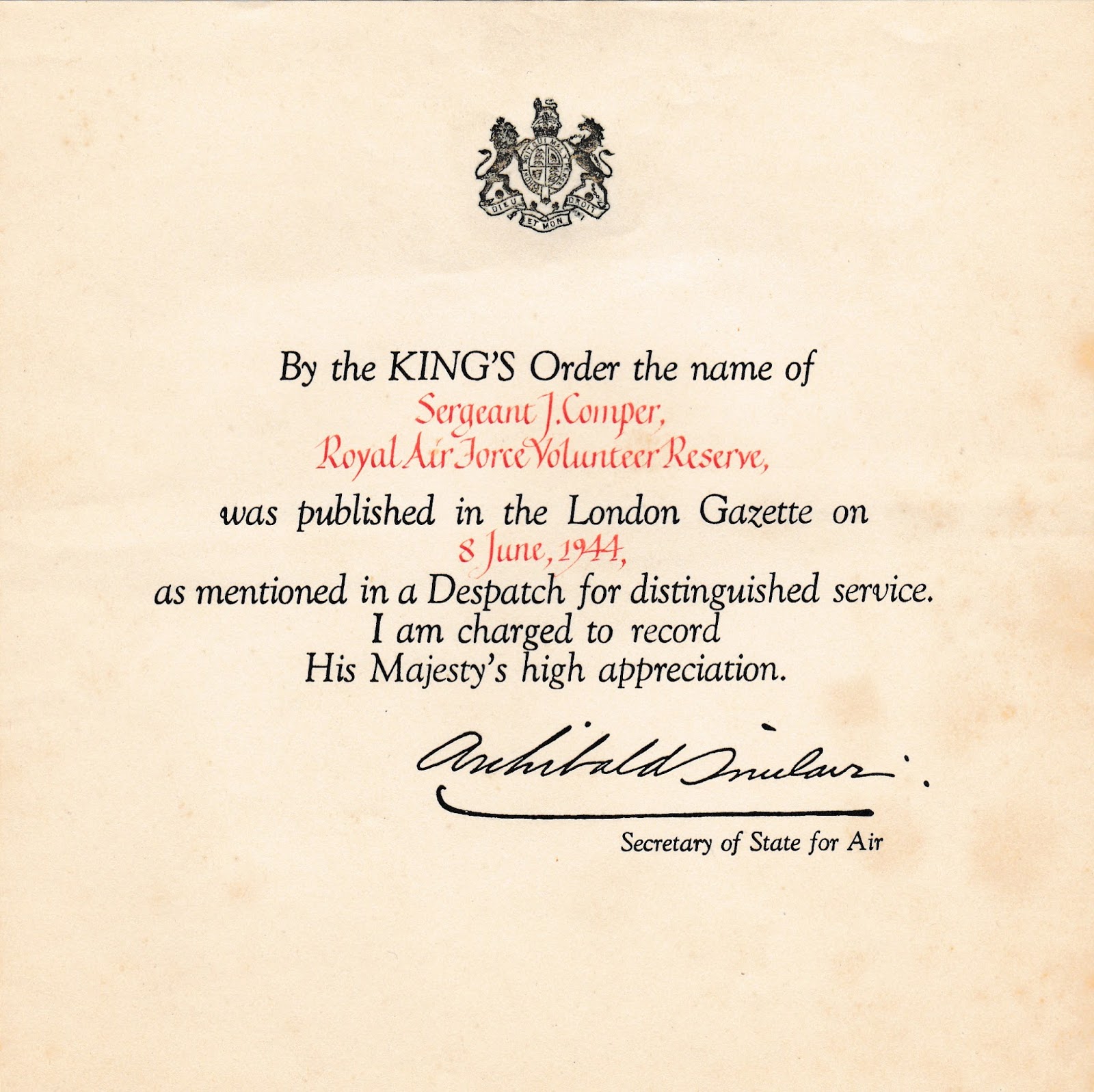
1944 he was awarded a Mention In Despatches for his prolonged good service.
His cherished award of the Squadron Badge
Mentioned in Despatches
By
the end of the War, he had served with 304 Squadron at 14 RAF Stations, these
being: Bramcote (Warwickshire), Syerston (Nottinghamshire), Lindholme
(Yorkshire), Tiree (Inner Hebrides), Dale (Pembrokeshire), Talbenny
(Pembrokeshire), Docking (Norfolk), Davidstow Moor (Cornwall), Predannack
(Cornwall), Chivenor (Devon), Benbecula (Outer Hebrides), St Eval (Cornwall),
North Weald (Essex) and Chedburgh (Suffolk).
He
was a kind and even-tempered man, with impeccable manners, quiet but not shy,
and loved telling silly jokes and riddles. His genial and straight-forward approach to his work, coupled with his skill
at untangling problems, seems to have been appreciated by the squadron.
Eventually he became the assistant Adjutant, “working with a Polish officer who spoke quite good English (better,
anyway, than my Polish!).”
In
November 1945 he received news that his brother, George, had died in a Japanese
POW camp in Borneo, a few days after it was liberated but before he could be
moved out. George was a Lance Corporal in the 3rd Battalion of the
Straits Settlements Volunteer Force, which had been over-run by the Japanese
during their invasion of Singapore. The news of his death was all the worse
because a telegram in September had said that George was alive and on his way
home. He had in fact died on 14th June, their mother’s birthday.
John
was demobbed on 25 February 1946 and returned to London and his job at the
Science Museum. His RAF release book states ‘He possesses initiative,
confidence and ability of exceptional standard and has capably performed
superior duties.’
Highly thought of by his Polish Commanding Officer
Five
months after returning to civilian life he received a parcel from 304 Squadron
– a monogrammed cigarette case, hand - made by one of the Polish craftsmen.
Inside was a list of everywhere they had been stationed, and also engraved was
a personal message :- “To Johny Comper
From the flying personnel with warm appreciation for your most valuable work with
304 Polish Squadron since its beginning 1940 to 1946”. Accompanying this
gift was a letter from Wing Commander Witold Piotrowski thanking John for his
long and devoted service and helping them over so many difficulties, not all of
which were quite “in the line of duty”.
Presentation of engraved cigarette case
in appreciation of his service
in
July 1946 John met Joyce Hobbs, an employee at the Science Museum, and by the end of the year they were
engaged. On 9th July 1947 they were married, the ceremony took place
at All Saints Church, Fulham. They moved to a flat in West Kensington. In 1950 they moved to a house in Barnes, SW
London and had their first child, a daughter. John’s mother moved in to live
with them and two years later a second daughter was born.
Wedding Photos of John and Joyce
Over
the following years John developed an interest in horticulture and became an
accomplished gardener, as well as developing a talent for being able to fix
almost anything. If he couldn’t mend something he would soon find out how to do
so. In the evenings he enjoyed reading, usually having several books on the go,
especially spy stories.
Soon
after returning to the Science Museum, John had been moved to the Ministry Of
Education, where he served variously in Establishments Branch, Legal Branch and
Further Education Branch until he was appointed Superintendent of the Science
Museum in 1950. He returned to the main office of the Ministry of Education in
1953 as Chief Establishment Officer and Departmental Security Officer. He
stayed in this post until appointed as the Establishment Officer of the Natural
Environment Research Council on the formation of that body in 1965. A year later he was recalled to the Department
of Education and Science to become Assistant Accountant General, which post he
held until his retirement in 1975. In
recognition of his services to education he was appointed a Companion of the
Imperial Service Order (ISO) in the New Year Honours List for 1972 - a fact
that was recorded in the Supplement to the London Gazette on 1st January 1972.
The Imperial Service Order
Notification of his Imperial Service Order
Report from The Richmond and Twickenham Times
For
several years John had been renovating a Norfolk farmhouse at weekends and by
1977 he and Joyce had moved there and begun a happy and active retirement. The
large garden was made attractive, and on land to the side they grew masses of
fruit and vegetables. They often visited their daughters and grandchildren
locally, as well as friends and family in London.
When
not absorbed in the gardening John could frequently be found in his workshop
making something useful from wood, metal or clay. Later he took up
silversmithing, making rings and brooches for his family.
John and Joyce shared a passion for genealogy and
often spent a considerable part of each year travelling up and down the country
to further their research. On 21 October 1993 they were consulting the archives
at Colchester Register Office when John suffered a heart attack and died. He
was 77. His funeral was held at St.Faith's Crematorium near Norwich. He is
survived today by his two daughters, four grandchildren and five great
grandchildren.
With thanks to his Grandson, Ben Haslam for access to the family archives and permission to use the photographs




 Posts
Posts

